
Expanding to a New Market? Google Ads’ AI Can Clone and Translate Your Search Campaign
Selling to customers abroad usually means rebuilding your ads in another language, one headline at a time. Google is now testing a shortcut. The Google Ads AI campaign localization tool, currently in beta, copies an entire Search campaign and translates it for a new market.
It sounds like a big time-saver, and in the right situation it is. But the fine print matters, especially for businesses based in India. If you run paid search for your business, here is what the tool really does and where it stops.
What the Tool Does
In plain terms, it works like a smart photocopier with a translator attached. The same page lists what it handles:
- Text and keywords. Headlines, descriptions, sitelinks, callouts and keywords are translated.
- Images with text. If an image has text on it, the AI removes the text and adds the translated message as separate text assets.
- Landing pages. You can add a code snippet that translates your page for visitors who click the ad, or update your URLs by hand.
- Budgets and bids. These are copied exactly from the original campaign.
New campaigns are published as paused by default, so nothing goes live until you say so.
The Limit Indian Advertisers Should Check First
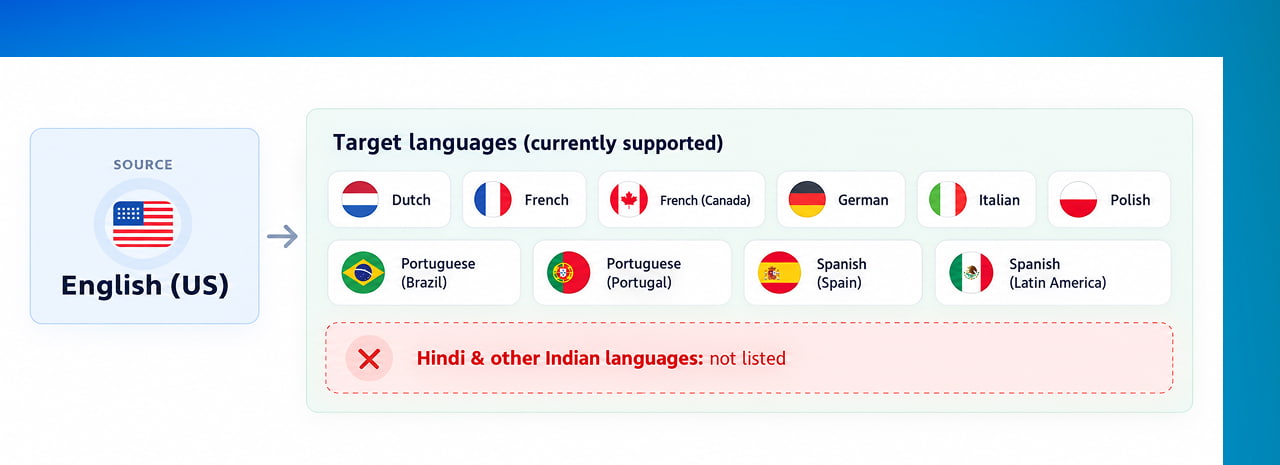
This is the part that is easy to miss. According to the same Google page, the tool works with English (US) as the original language, and the target languages are all European or Latin American: Dutch, French (including Canadian), German, Italian, Polish, Portuguese (Brazil and Portugal) and Spanish (Spain and Latin America).
Hindi and other Indian languages are not on the list at the moment. So this tool is a fit if you are an Indian business selling to Europe or Latin America. It is not a way to run Hindi, Tamil or Telugu campaigns for customers at home. Google adds that more target languages are due by the end of 2026, so it is worth checking the page again later.
The Review Step: Back-Translation
Before anything goes live, the tool shows a review table with four columns: the original text, the translated text, the translation turned back into English, and notes about the translation. You can edit any line directly. You can also give the AI instructions, such as telling it not to translate your brand name.
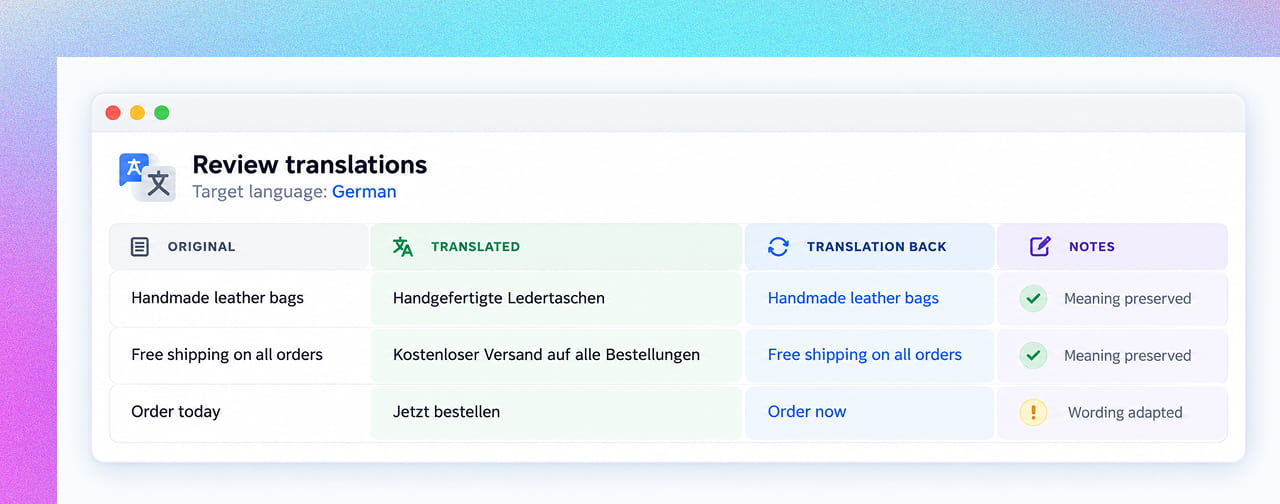
The back-translation is clever because you don’t need to speak the target language to check the meaning. But it has a limit, and this is our view rather than Google’s: it can confirm that the meaning survived, not that the ad sounds natural or persuasive to a native reader. A line can be accurate and still feel stiff or odd. For anything you plan to spend real money on, ask a native speaker to read it.
Budgets and Bids Are Copied, Not Adjusted
Google’s page says budgets and bids are copied exactly, with no currency or exchange-rate conversion. A $100 budget simply stays a $100 budget. The setup steps also let you set the new campaign’s location and budget, so check both before publishing.
The bigger point is that a new market has its own click costs and competition. Numbers that worked at home may be too high or too low abroad, so treat the copied values as a starting point, not a plan.
What About the Landing Page?
A translated ad that lands on an English page wastes the click. The tool offers a snippet that translates your page automatically, which is quick but is still machine translation. For a market you are serious about, a properly translated page usually converts better, and that may mean building language versions of your website.
A Sensible Way to Try It
- Check eligibility. Your campaign needs to be a Search campaign in English (US), active or paused, and within Google’s size limits.
- Start with one campaign in one market. A small test teaches you far more than cloning everything at once.
- Add instructions. Protect brand names and set the tone you want.
- Review every line. Use the back-translation, then have a native speaker check the key ads.
- Keep it paused until you are happy. Then set the budget and bids for that market deliberately.
Quick Takeaways
- The Google Ads AI campaign localization tool (beta) clones a Search campaign and translates it into a new language, creating a separate new campaign.
- It currently works from English (US) into ten European and Latin American languages. Hindi and other Indian languages are not on the list.
- Budgets and bids are copied exactly with no conversion, so set them for the new market yourself.
- A back-translation column lets you check the meaning, but not whether the ad sounds natural.
- It is a good fit for Indian businesses expanding to Europe or Latin America, if you review the output carefully.
Planning to Advertise in a New Market?
A faster translation is only one piece of a successful launch. Reach out through our contact form and we’ll help you plan the campaign, the landing pages and the budget for your target market.


 +91 8277203000
