
Google Says EU Rules Caused Its Biggest Search Quality Drop Ever — What Indian Businesses Should Know

A quick note before we dive in: you may have seen this story referred to as being about “EU privacy rules.” That’s a mix-up — the actual news is about the EU’s Digital Markets Act, which is a competition (antitrust) law, not a privacy law. It’s easy to confuse the two since both come out of Brussels and both restrict how Big Tech companies operate. We’ll explain the real story clearly below — it’s a useful case study for anyone thinking about their own digital marketing strategy.
What Actually Happened
On September 8, 2026, Google rolled out major changes to how search results look for users across the European Union. The company itself said, in a statement to Reuters, that this is the biggest drop in search quality in its nearly 29-year history — and it made a point of saying so publicly, almost as a protest.
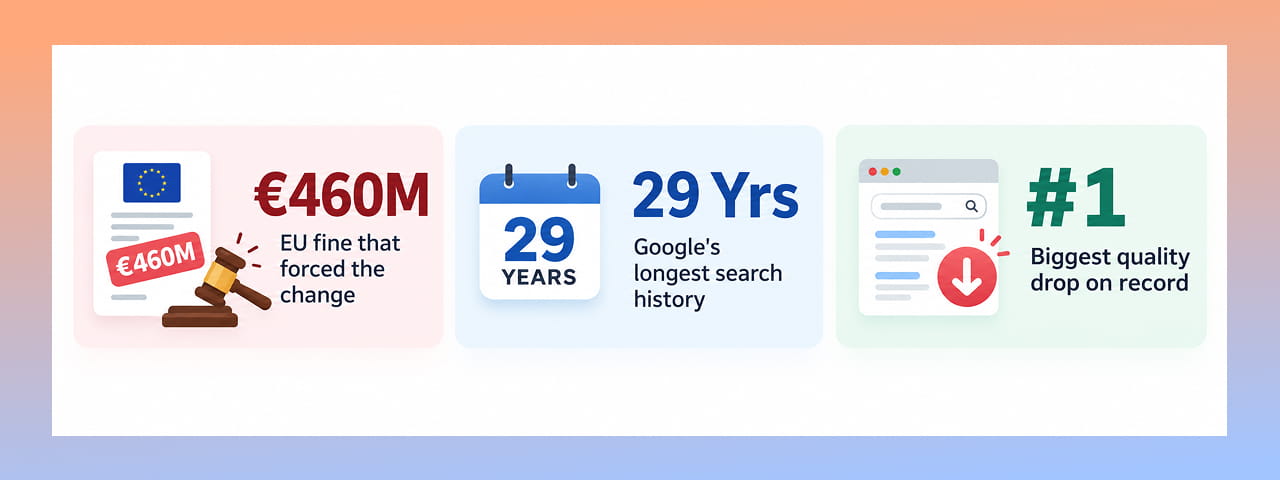
Why would Google deliberately make its own product worse and then announce it? Because it didn’t have a choice. The European Commission (the EU’s main regulatory body) fined Google €460 million (roughly ₹4,600 crore) under the Digital Markets Act for something called “self-preferencing” — essentially, favouring its own services like Google Flights, Google Hotels, and Google Shopping by placing them above competitors in search results, even when a competitor might have been more relevant or useful.
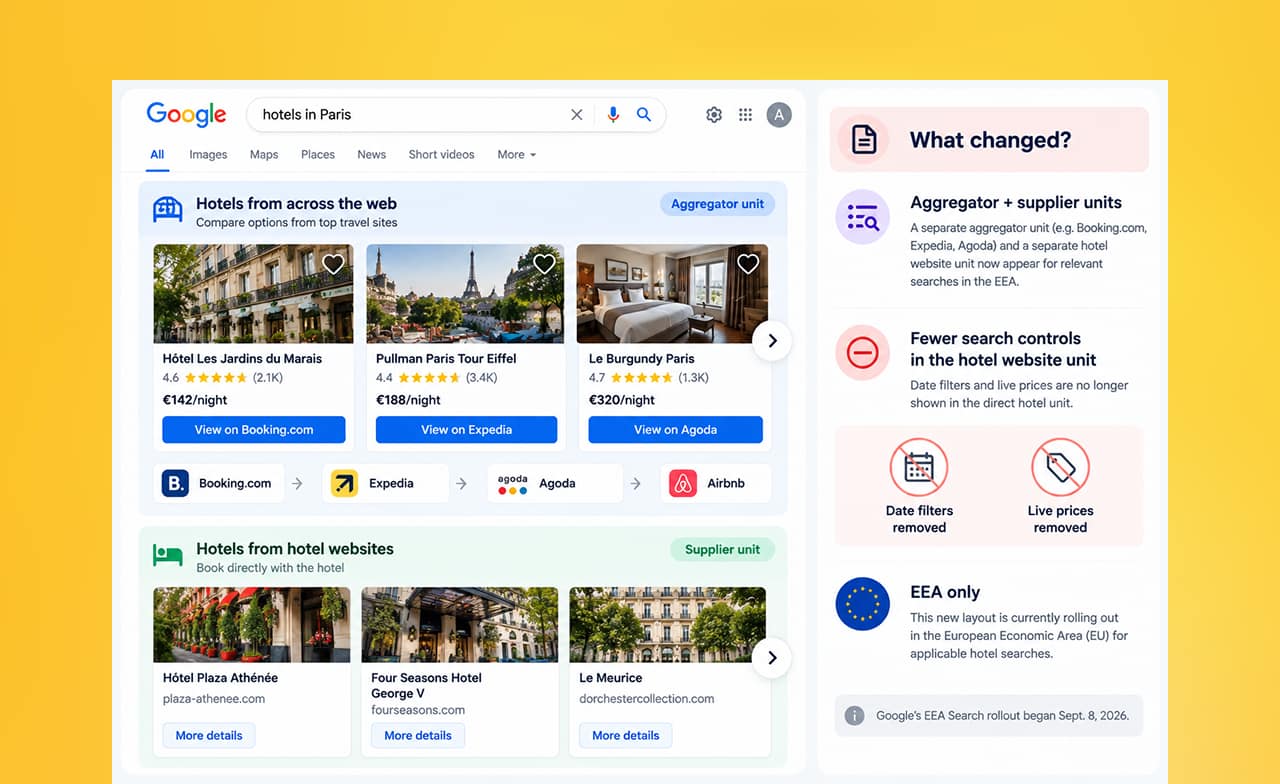
To comply, Google has now changed how results for things like hotels, flights, and restaurants appear for EU users:
- A single specialised search service (like a travel comparison site) now appears at the top of the results for a relevant search.
- Two more competing services appear below it, but with fewer details shown.
- A scrollable row of options follows — but Google has removed live pricing information from it, something users used to see instantly.
Wait — Why Should This Matter to a Business in India?
Fair question, since this change only directly affects users physically searching from the EU. But there are three real reasons this is worth understanding, even from Hosur or Bengaluru:
- It shows how much power regulators now have over how Google search actually looks. For years, businesses have treated “how Google displays results” as a fixed, unchangeable fact of life. This story proves that isn’t true — governments can, and increasingly do, force structural changes.
- It’s a preview of a trend, not a one-off. The EU has already fined Google over €10 billion cumulatively since 2017 for similar issues. Other governments — including regulators in the US and UK — are watching closely and considering their own versions of these rules. It’s reasonable to expect similar conversations to eventually reach other markets.
- It’s a reminder not to build a business entirely dependent on one platform’s goodwill. Whether it’s an algorithm update, a regulatory order, or a policy change, the way Google displays your business can shift for reasons completely outside your control — and often with little warning.
What “Self-Preferencing” Actually Means, In Plain Terms
Since this term is at the heart of the whole story, it’s worth explaining properly. Self-preferencing is when a company that runs a major platform (in this case, Google’s search engine) also runs competing services on that same platform (Google Flights, Google Hotels) — and then quietly gives its own services better placement than outside competitors, even when a neutral ranking might have put someone else first.
Regulators consider this unfair because Google effectively controls the playing field and has its own player on the field. The Digital Markets Act specifically targets this kind of behaviour by companies large enough to be labelled “gatekeepers” — Google, Apple, Amazon, and Meta are among them.
The Bigger Lesson for Any Business That Relies on Google
Regardless of where in the world you operate, this story is a useful reminder of something every business owner should keep in mind:
- Don’t build your entire visibility strategy around one channel. If Google search results can change structurally overnight because of a regulatory order, relying solely on organic Google rankings is riskier than it might feel.
- Diversify where people can find you — a mix of search visibility and digital marketing, social media presence, direct traffic (people typing your website address directly, or coming from WhatsApp, email, and referrals), and paid channels gives you a cushion when any one platform changes its rules.
- Watch how these regulatory battles play out, because rules written for the EU today have a track record of eventually influencing policy conversations elsewhere.
Quick Takeaways
- This story is about the EU’s Digital Markets Act (a competition law), not privacy rules — a distinction worth remembering if you see it referenced elsewhere.
- Google was fined €460 million and was forced to change how travel and hospitality results are displayed to EU users, which the company itself called the biggest quality drop in its search history.
- The change stems from “self-preferencing” — Google favouring its own services like Flights and Hotels over independent competitors.
- Even outside the EU, this signals how much regulatory pressure can reshape a platform businesses depend on, often with no advance warning to the businesses affected.
- The safest long-term strategy is not depending entirely on any single platform for visibility.
Want a Visibility Strategy That Isn’t Dependent on One Platform’s Rules?
If most of your business’s visibility currently comes from just one channel, this is a good moment to build a more balanced approach. Reach out through our contact form and we’ll help you put together a strategy that spreads the risk sensibly.


 +91 8277203000
