
There’s No Single ‘Right Answer’ in SEO, Google Says — Here’s How to Make Better Decisions Anyway

If you’ve ever searched for “the right way” to do something in SEO — should this be one page or two? should I use this heading or that one? — and come away more confused than when you started, you’re not alone. And according to Google itself, that confusion sometimes isn’t your fault. There genuinely isn’t always a single correct answer.
SEO decision making is rarely as simple as finding one rule and applying it to every website. Google’s John Mueller recently highlighted this point when responding to a question about whether an existing article should be expanded or whether a related subtopic should become a separate page. His answer was that there is not always an absolute right answer, meaning SEO professionals often need to evaluate the context, choose a defensible approach, and measure the results.
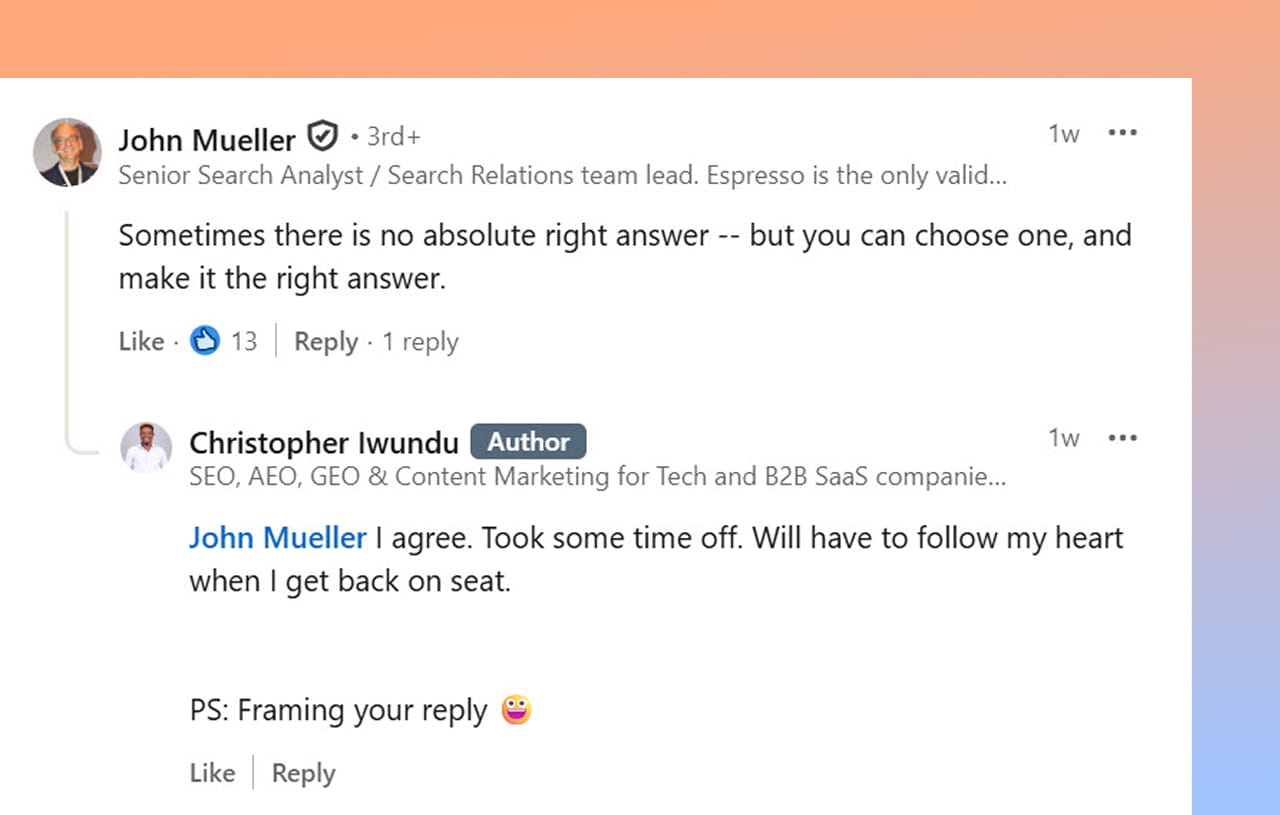
Google’s John Mueller (a long-time public voice from Google’s search team) said exactly this recently. Someone asked him a very specific, very common SEO dilemma: they had an existing page that clearly needed more content, but part of that content — a related sub-topic — felt like it deserved to be its own separate page instead. Should they expand the existing page, or split it into two?
Mueller’s answer: “Sometimes there is no absolute right answer — but you can choose one, and make it the right answer.”
Let’s unpack why that’s actually useful advice, not a non-answer — this is exactly the kind of question that comes up often in content strategy work.
Wait — Isn’t SEO Supposed to Have Clear Rules?
It’s understandable to expect SEO to work like a checklist — do these ten things correctly, and you’ll rank. And for some things, that’s true: a page needs to load reasonably fast, it needs to be crawlable, it shouldn’t have broken links everywhere. Those are closer to right-or-wrong facts.
But a huge portion of SEO decisions aren’t technical facts — they’re judgment calls about what will genuinely serve the person reading your content best. And judgment calls, by definition, don’t have one universally correct answer. They depend on your specific content, your specific audience, and what you’re trying to achieve.
The “expand this page or split it into two” question is a perfect example. Both choices can work well, depending on details Google has no way of knowing about your particular situation — how deep the sub-topic really goes, whether your readers would want it separately, how your website’s structure is already organized.
What “Choose One, and Make It the Right Answer” Actually Means
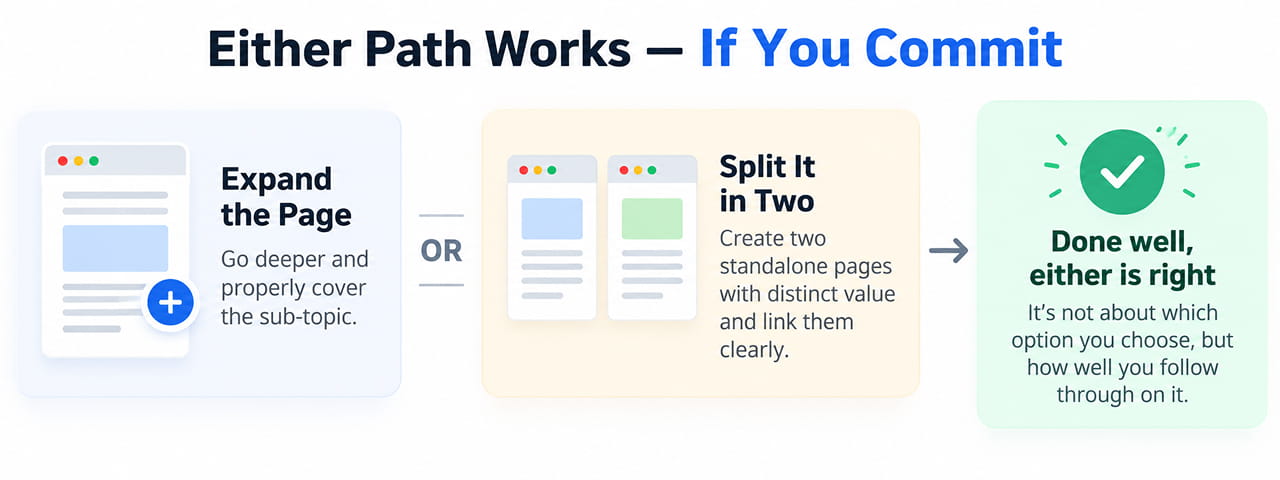
This is the part worth sitting with, because it’s a genuinely different way of thinking about decisions than most people default to. Mueller isn’t saying “it doesn’t matter what you pick.” He’s saying something more useful: the quality of your decision depends less on which option you pick, and more on how well you follow through on it.
In other words — if you decide to split your content into two pages, “making it the right answer” means:
- Genuinely making sure each page stands on its own, with real, distinct value
- Linking the two pages together clearly so readers (and Google) can find both
- Not leaving one of the two pages thin or half-finished, just because you technically “created” it
If you’d instead chosen to expand the existing page, “making it the right answer” would mean writing that expansion properly — genuinely covering the sub-topic well, not just bolting on a rushed paragraph to tick a box.
Either choice, done properly, works. Either choice, done half-heartedly, fails — regardless of which one was theoretically “more correct.”
SEO Decision Making Framework: Why This Is Actually Reassuring News
For business owners who feel stuck second-guessing every content decision, this should take some pressure off:
- You don’t need to find the mythical “perfect” structure before you start. A reasonable decision, executed well, beats an endless search for a perfect one that doesn’t exist.
- Indecision has a real cost. Time spent debating “page A or page B” is time not spent actually writing content that helps your readers — and that content is what genuinely earns visibility.
- This applies well beyond this one example. Should this be a blog post or a landing page? Should this be one long guide or three shorter ones? Many SEO questions fall into this same “no single right answer, but a right way to execute either choice” category.
A Simple Way to Make These Decisions Going Forward
Next time you’re stuck on a similar fork-in-the-road decision, try asking these questions instead of searching for “the” answer:
- Which option would genuinely be easier for a real reader to understand and use? Not “which is better for SEO” — which one actually serves the person reading it.
- Do I have enough content to properly support both options? If splitting a topic in two would leave one page thin, that’s often a sign to keep it together.
- Once I decide, am I willing to commit and do it properly? The plan only works if you follow through — a rushed version of the “right” choice will still underperform a well-executed version of the “wrong” one.
- Would a fresh set of eyes help? Sometimes an outside website design and content perspective spots the obvious answer faster than staring at the decision yourself.
- Can I always adjust later? Content structure isn’t permanent. If a decision turns out to be wrong once you see real reader behavior, you can restructure it then — don’t let the fear of an imperfect choice stop you from making one at all.
Quick Takeaways
- Google’s John Mueller confirmed something many marketers suspected: not every SEO question has one objectively correct answer.
- Some decisions — like splitting content into two pages versus expanding one — genuinely can go either way, depending on your specific situation.
- What matters more than which option you pick is how thoroughly and thoughtfully you execute it.
- Getting stuck searching for a “perfect” answer often costs more (in time and delayed progress) than simply making a reasonable decision and committing to it properly.
- This mindset applies to many recurring content-structure dilemmas, not just this one specific example.
Stuck on a Content Decision You Can’t Seem to Settle?
If you’ve been going back and forth on how to structure or expand your content, sometimes an outside perspective is all it takes to move forward with confidence. Reach out through our contact form and we’ll help you make the call — and execute it properly.


 +91 8277203000
