
The Hidden Costs of Choosing the Cheapest Website Developer in India

Search for a website developer in India and you’ll find quotes spanning an enormous range — freelancers offering a full site for ₹35,000, agencies quoting ₹2 lakh for what looks like the same set of pages. For a cash-strapped business, the cheapest quote can feel like the obvious choice. Why pay more for something that looks identical on the surface?
Hiring the cheapest website developer may seem like the best way to save money, but the lowest price often comes with hidden costs. Limited functionality, poor performance, security issues, and expensive redesigns can quickly outweigh the initial savings. Before choosing a developer based solely on price, it’s important to understand the true cost of website development.
The gap becomes clearer once you look at what a properly built website actually involves. A 2024 Clutch survey found that small businesses typically invest between $3,000 and $15,000 in a professionally built website — a range that reflects real hours of discovery, design, development, and testing, not just a template with your logo dropped in.
A rock-bottom quote isn’t necessarily a red flag on its own, but it usually means something in that process has been skipped. The problem is that the missing pieces rarely show up on day one. They show up three, six, or twelve months later — as costs nobody budgeted for. Here’s where they tend to hide.
1. Why Businesses Choose Cheapest Website Developer: The Technical Debt You Inherit on Day One
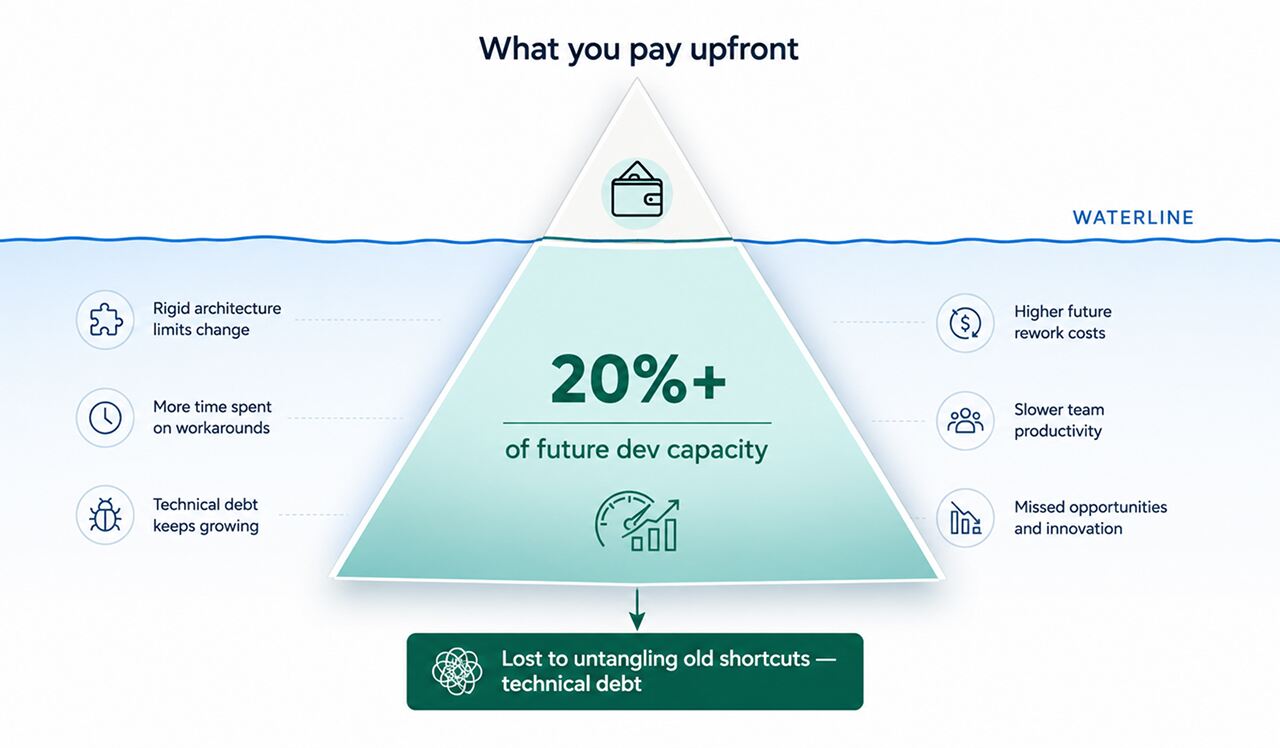
Cheap builds are fast builds, and fast builds cut corners in the code itself — hardcoded values instead of flexible systems, copy-pasted sections instead of reusable components, no documentation explaining how any of it works. Developers call this technical debt: shortcuts taken now that cost more to unwind later.
This isn’t a minor inconvenience. Research from McKinsey & Company, cited in an analysis of software budget overruns, found that technical debt can consume more than 20 percent of a development team’s capacity — meaning a fifth of every future project on that codebase goes toward untangling old shortcuts instead of building anything new.
For a small business, that translates directly into cost: every new page, every feature request, every small change takes longer and costs more than it should, for as long as the site is built on that foundation.
2. The Redesign You End Up Paying for Twice
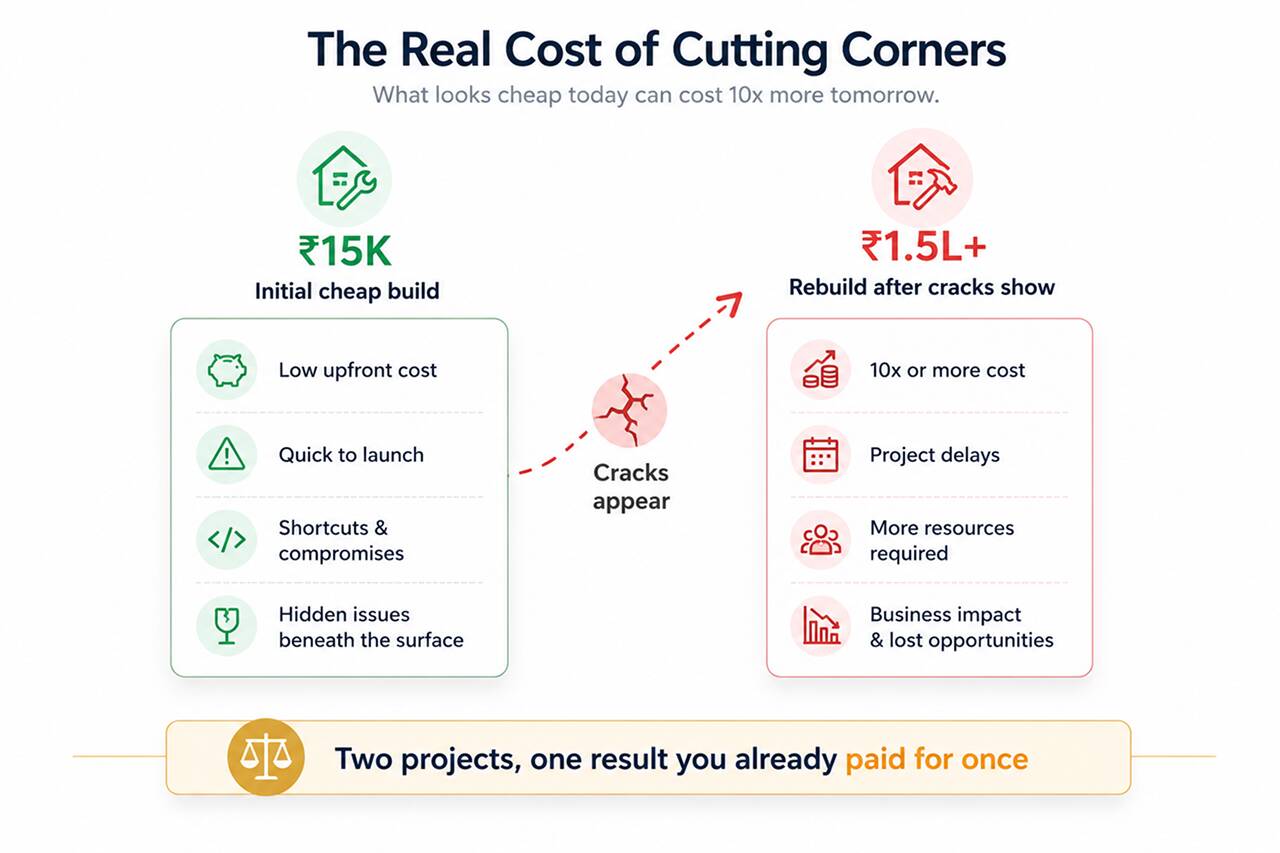
The same analysis found that around 70 percent of software projects exceed their initial budget, with an average overrun of 27 percent — and the pattern is even sharper at the low end of the web development market, where an unrealistically low quote almost always means the scope was underestimated, not that the work is genuinely cheaper to do. When that gap surfaces mid-project, businesses are usually offered two options: pay more to finish it properly, or accept a version with two rounds of quality baked in — one bad rebuild masquerading as a launch, and a real rebuild that follows a year or two later once the cracks become impossible to ignore.
That second website isn’t a hypothetical. It’s a second full project cost, on top of the first one, to get to where a properly scoped build would have landed the first time.
3. The Security Patch That Never Happens
A rock-bottom project fee rarely includes anything for what happens after launch — and security is the first thing to go unmanaged. That gap has a measurable cost. The Sophos State of Ransomware 2025 report, based on thousands of real ransomware incidents, found that exploited vulnerabilities were the single leading root cause of attacks for the third year running, responsible for 32 percent of all incidents — very often through flaws a patch already existed for.
A developer who disappears after handover isn’t coming back to apply that patch. For a business that can’t afford a security incident, that’s a much larger bill waiting quietly in the background.
4. The Credibility You Lose in the First Five Seconds
Budget builds tend to look the part of budget builds — generic templates, stock imagery that doesn’t fit the brand, layouts that feel slightly off on mobile. Visitors register that instantly, even if they couldn’t articulate exactly what’s wrong. Stanford University’s Web Credibility research found that a majority of people judge a company’s credibility largely based on the overall visual design of its website, before reading a single word of content.
That’s a cost that never appears on an invoice: the customer who quietly decided not to trust the business, and never reached out to say why.
5. The SEO Foundation You’ll Have to Redo From Scratch
Search visibility is built on structure — clean URLs, proper heading hierarchy, fast load times, mobile usability, and code search engines can actually read. Budget builds routinely skip all of it, because none of it is visible in a quick demo of the finished pages.
The cost shows up later as a second, separate project: rebuilding the technical foundation before any SEO investment can actually work. Businesses often end up paying for SEO services twice — once that fails quietly because the underlying site can’t support it, and once after a developer has gone back in to fix the structural issues first.
The Real Math: Why Cheap Often Costs More
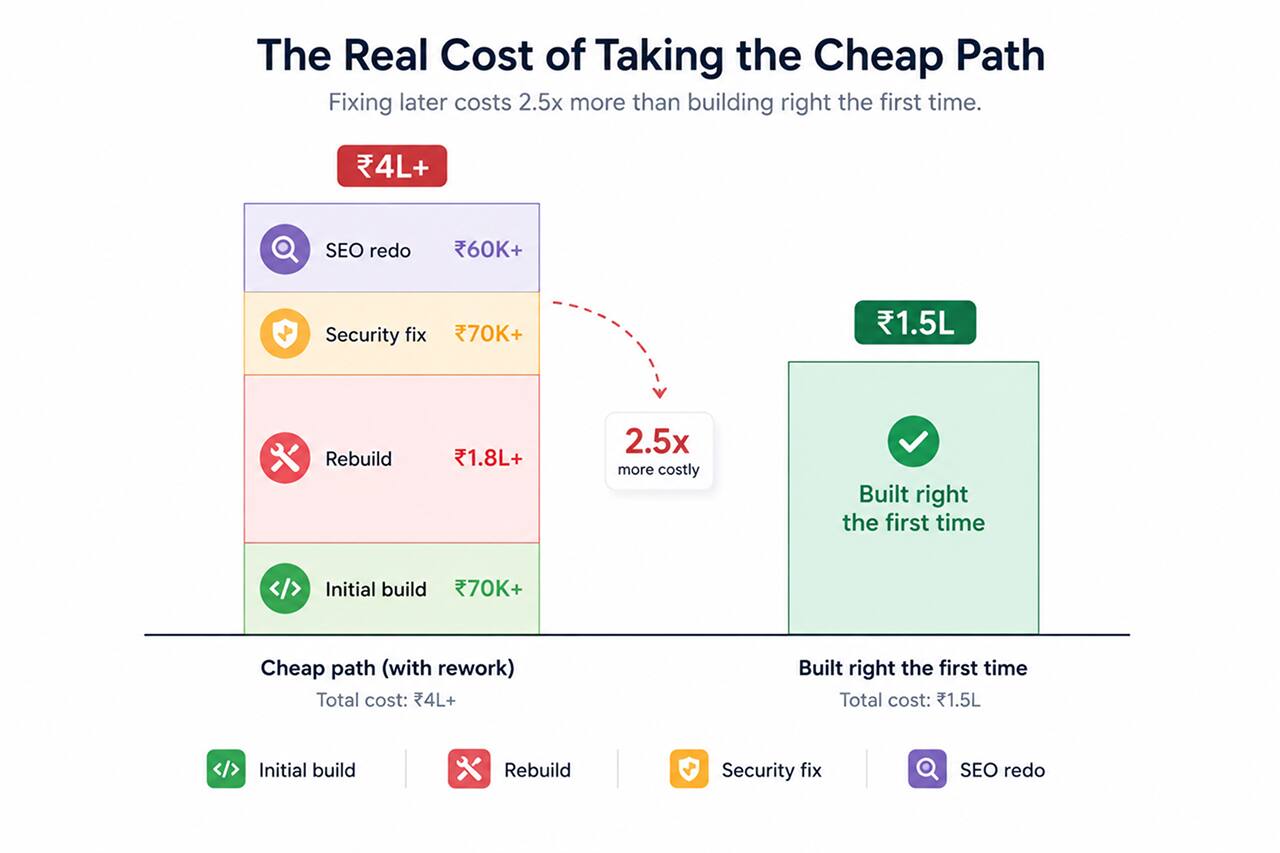
None of this means every low-cost developer in India delivers bad work, or that every expensive quote guarantees a good one. Price alone isn’t the signal to trust. But an unrealistically low quote is rarely a discount — it’s usually a preview of costs that have been deferred, not eliminated: the rebuild, the security incident, the SEO redo, the customers who left without saying why.
Add up technical debt, a probable rebuild, unpatched security risk, lost credibility, and a redone SEO foundation, and the “cheap” website is very often the more expensive one by the time the business has what it actually needed in the first place.
Ready to get an honest read on what your website actually needs? Reach out through our contact form and we’ll walk through your project scope together, so the quote you get reflects the real cost of doing it right the first time.


 +91 8277203000
