
Google Can Lose “Faith” in Your Whole Site Over Low-Value Programmatic SEO, Mueller Warns

A few days ago, Google’s John Mueller (he’s one of the main people at Google who talks publicly about how Search works) said something on social media that’s worth every Indian business owner’s attention: Google can lose “faith” in your entire website — not just one bad page — because of a strategy called programmatic SEO gone wrong.
If that sentence is already confusing, don’t worry. Let’s slow down and explain it from scratch, in plain language, because this is genuinely useful to understand even if you’ve never touched a line of code — it’s a question that comes up often in our digital marketing work with businesses across India.
First — What Is “Programmatic SEO”?
Imagine you run a business that lists properties for rent across Indian cities. Instead of writing a separate page by hand for “2BHK flats in Koramangala,” “2BHK flats in Indiranagar,” “2BHK flats in Whitefield,” and so on for every locality, you build one template and let a computer fill in the blanks automatically. One click, and you’ve generated 5,000 pages.
That’s programmatic SEO — using a template and automation to create a large number of similar pages at once, usually swapping out one detail (a city name, a product name, a price range) each time.
It isn’t automatically a bad idea. Big, legitimate sites use it. The problem is what happens when those pages are created just to exist in Google’s search results, without actually being useful to the person reading them.
What Mueller Actually Said
Answering a website owner directly, Mueller explained that this kind of mass page-generation “often leads to a site that’s either spam, borderline spam, or low quality” — and here’s the part that should get your attention: he said Google’s systems may have “possibly lost faith in your site providing good value to users,” based on those old, thin pages.
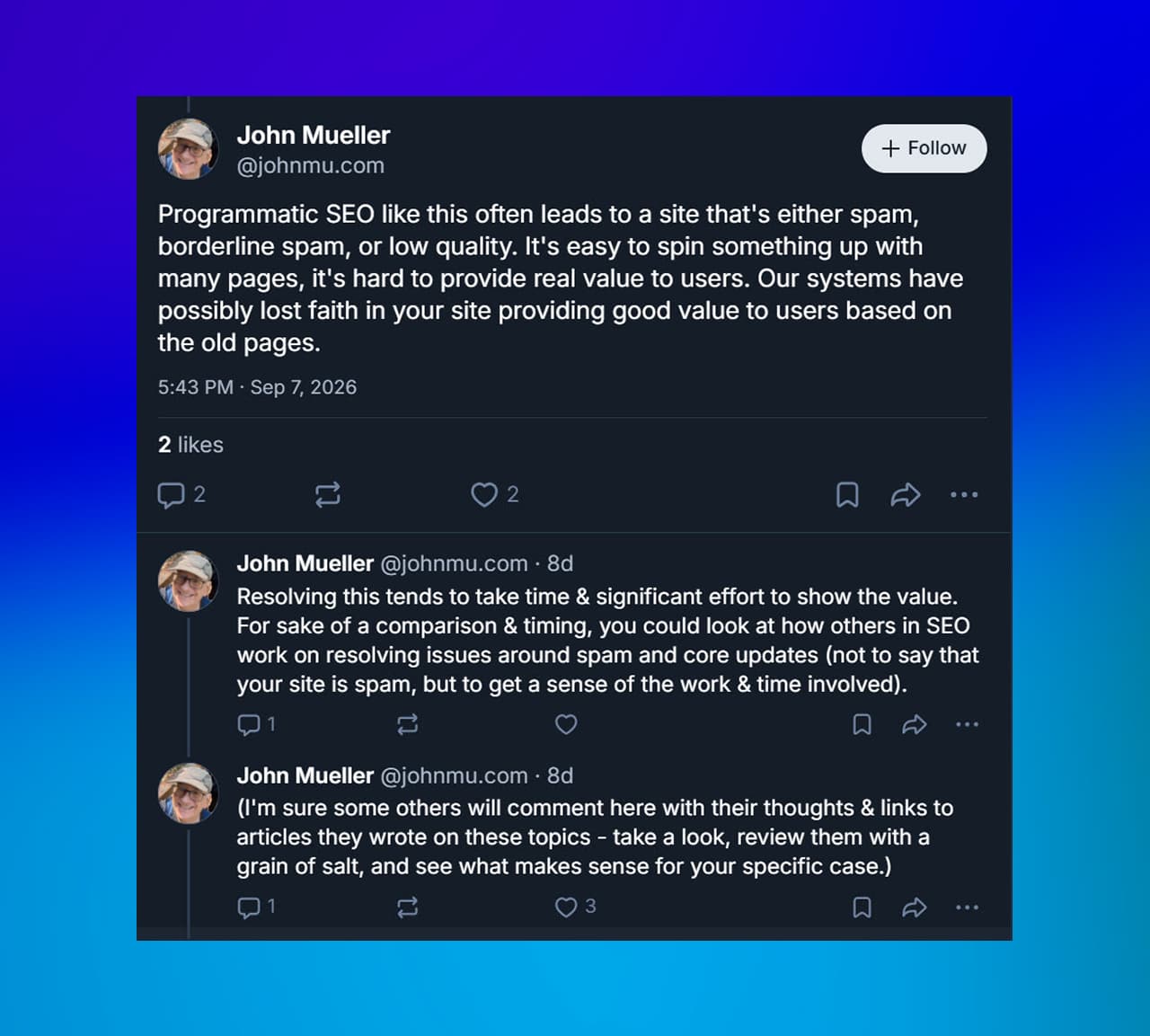
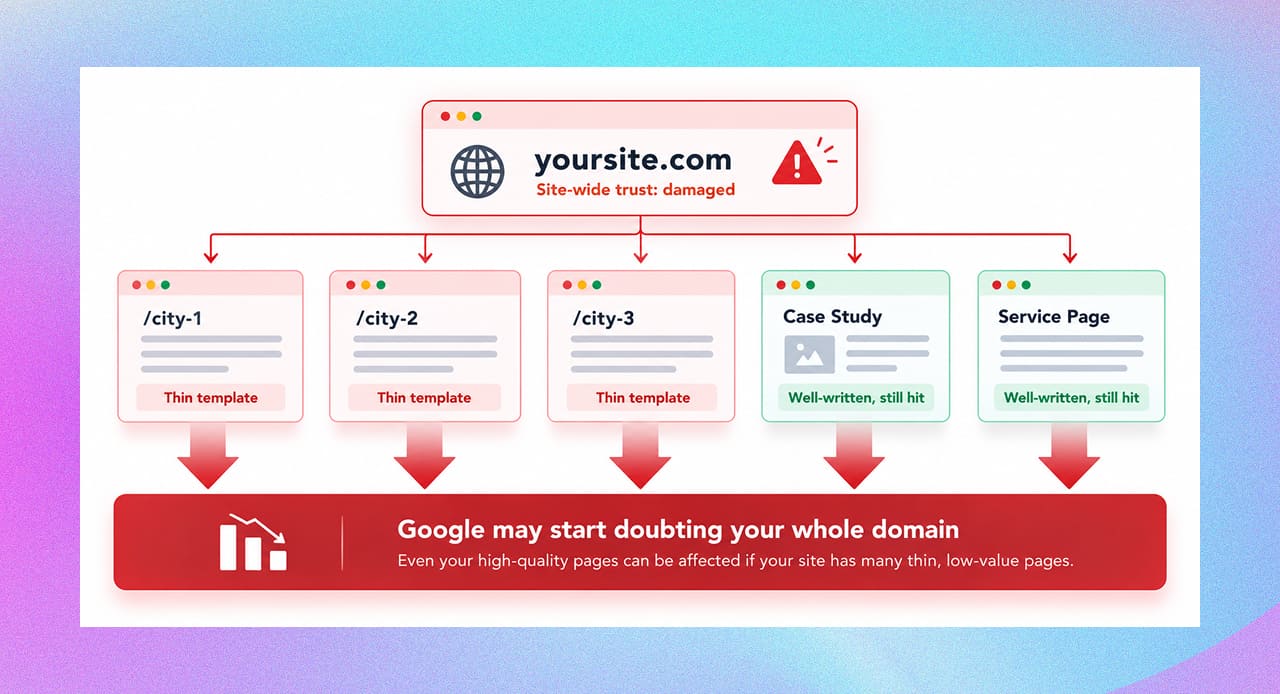
In other words, this isn’t a case of one weak page getting buried in search results while the rest of your website is fine. Mueller was describing something much bigger: Google can start doubting your whole domain, including pages that had nothing to do with the problem — a carefully written service page, a detailed case study, an honest blog post — because they all sit on the same website as the low-value ones.
He also said fixing this “tends to take time and significant effort,” comparing it to the kind of slow recovery businesses go through after being hit by a spam penalty or a major Google algorithm update. No quick fix, no shortcut — just consistently showing Google, over time, that the site is genuinely worth trusting again.
Why This Should Matter to You, Even If You’ve Never Heard the Term “Programmatic SEO”
You don’t need to be running a 5,000-page property listing site for this warning to apply to you. It’s relevant any time content gets created mainly to “cover more search terms” rather than to genuinely help the person reading it. A few everyday examples:
- A local clinic creating a near-identical page for every single treatment and every single nearby locality, with barely any real content changed between them.
- An online store generating a product page for every possible colour and size combination, each with the exact same three-line description copy-pasted.
- A services business publishing dozens of thin “X vs Y” comparison pages just to rank for search terms, without real research behind any of them.
If a website is doing this — even with good intentions, just trying to “be visible everywhere” — it runs the exact risk Mueller described.
What Healthy Programmatic Content Looks Like
The good news: Google isn’t banning this technique. Templates and automation are fine. What separates a healthy page from a risky one usually comes down to a simple question: does this specific page tell the reader something they couldn’t get from any of the other 4,999 pages on the site?
A page that’s healthy usually has:
- Real, specific details for that exact page — actual local information for that locality, actual specs for that product, not filler text
- Original data, photos, prices, or examples that are genuinely unique to it
- A reason for a real human to land on it and stay, not just a reason for it to exist in Google’s index
A page in the danger zone usually has:
- The same three sentences repeated with only a city or product name swapped
- Little to no unique information beyond that one swapped detail
- No real evidence anyone (or anything) put thought into that individual page
What To Do If You Suspect This Applies to Your Site
- Take stock honestly. Pull a list of your site’s pages and be honest about how many were created from a template with minimal unique content per page.
- Don’t panic-delete everything. Removing pages can help, but Mueller’s comments suggest recovery isn’t as simple as just deleting the offending pages and expecting an immediate turnaround.
- Add real substance where it’s missing. For pages you want to keep, invest in making each one genuinely different and useful — this is often where good SEO and content strategy work makes the biggest difference.
- Expect this to take months, not days. Budget your effort and your expectations accordingly; Mueller himself compared it to spam and core-update recovery timelines.
Quick Takeaways
- Programmatic SEO means using a template to auto-generate many similar pages at once — not inherently bad, but risky when done carelessly.
- Google’s John Mueller confirmed that enough low-value, templated pages can make Google’s systems lose “faith” in your whole website, not just those pages.
- This can drag down even your well-written, genuinely useful pages, simply because they share a domain with the weak ones.
- Recovery is slow and requires real effort — there’s no quick fix once trust is lost.
- The safest path is making sure every page — templated or not — offers something a reader can’t get anywhere else on your site.
Worried Some of Your Pages Might Be Sending the Wrong Signal?
It’s a genuinely hard thing to judge about your own website — you know it too well to see it the way Google (or a first-time visitor) does. If you’d like an honest, outside look at whether your site’s pages are helping or hurting you, reach out through our contact form and we’ll take a look together.


 +91 8277203000
