
SEO Pros Rate What Actually Moves Rankings in 2026 — the Answer Might Surprise You

Google ranking factors are one of the most debated topics in SEO, and 2026 is no different. Every few months, someone online declares that a familiar piece of SEO wisdom is “dead” keywords are dead, backlinks are dead, blogging is dead. It makes for a great headline. It’s usually wrong, or at least a lot less dramatic than it sounds.
A fresh survey of 131 SEO professionals, published last month, put some of these claims to the test. The results are refreshingly boring in the best possible way — and genuinely useful if you’re trying to figure out where to actually spend your time and marketing budget.
What This Survey Actually Was
Two well-known SEO researchers ran a large survey asking 131 working SEO professionals to rate more than 100 possible Google ranking factors, from strongly negative to strongly positive. That produced over 13,000 individual data points — a genuinely large amount of collective opinion from people who work on this for a living.
It’s worth being precise about what this is and isn’t. This is not an official list from Google, and it’s not a leak of Google’s actual algorithm. It’s a structured snapshot of what experienced practitioners currently believe matters, based on what they observe in their own client work. Think of it as a large, well-organized panel of professional opinion — genuinely useful, but still opinion, not confirmed fact.
The Headline Result: Backlinks Are Not Dead
Here’s the top of the list, ranked by the percentage of respondents who named each factor as one of the three most important:
- Relevance / search intent match — 57.1%
- Backlinks — 54.8%
- Content quality — 47.6%
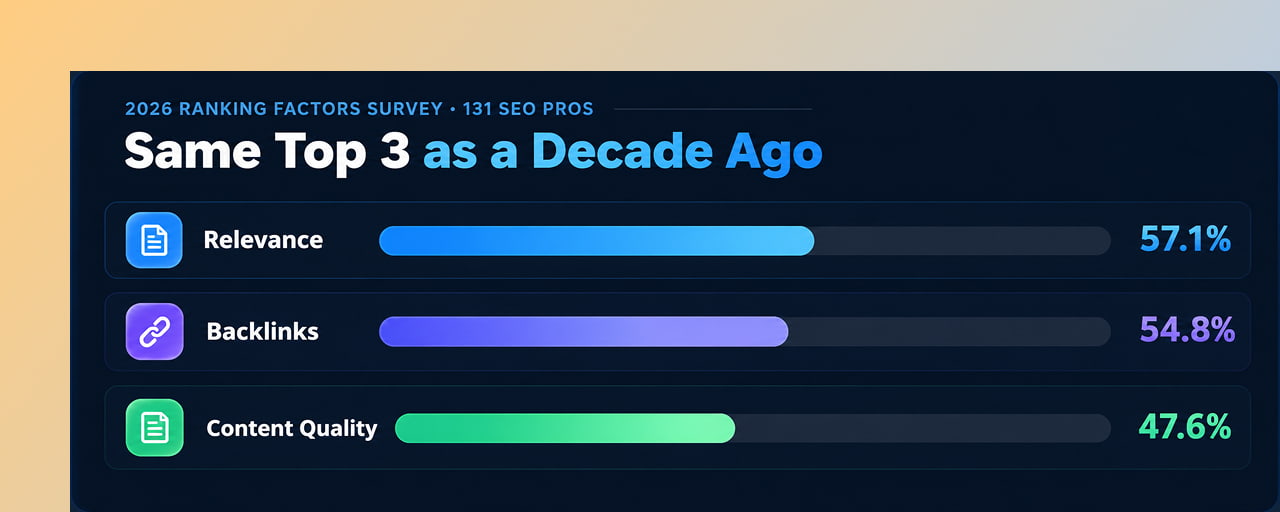
If those three names sound familiar, that’s the point. As the report’s authors put it, this is roughly “the same three as a decade ago.” Despite years of predictions that backlinks would fade in importance — especially with AI search tools now in the mix — more than half the panel still rated them among the top three signals. One of the researchers wrote plainly that “the rumor of the death of backlinks has been greatly exaggerated.”
What’s Actually New Isn’t the Winners — It’s the Details
The top three staying the same doesn’t mean nothing has changed. The more interesting shifts show up once you look past the headline ranking:
- What counts as “quality” content has narrowed. Respondents increasingly pointed to original research and first-party data — information nobody else has published — as the strongest markers of content quality, rather than just well-written, well-organized writing.
- AI-generated content isn’t rejected outright, but it is judged harshly at scale. The panel’s view, in short: using AI to help you write the same amount of content in less time is fine. Using AI to publish ten times more of the same shallow content is a problem. Quality, not speed, is what separates the two.
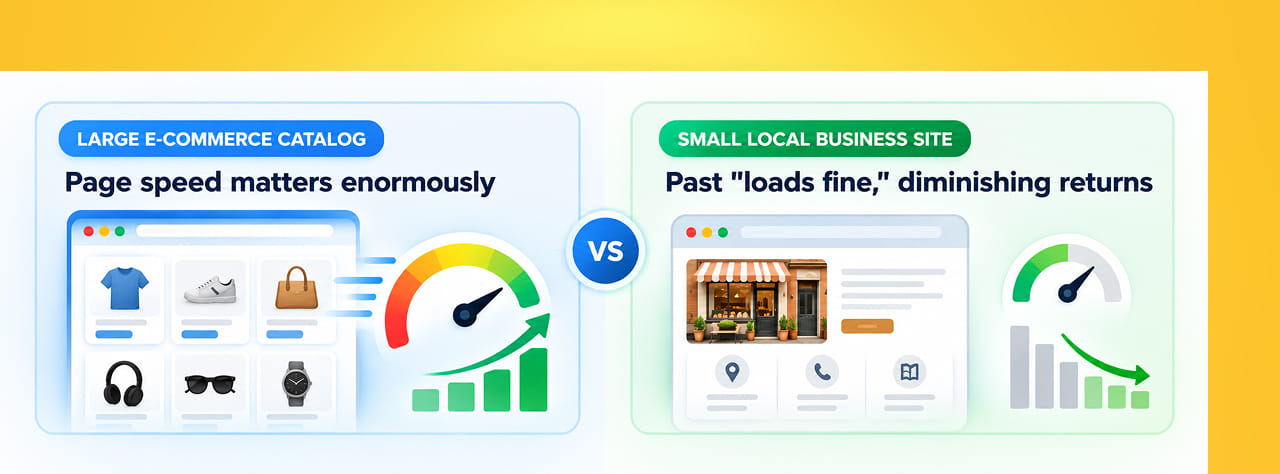
- Site speed and Core Web Vitals split the room. Some experts argued these are now over-rated — a page either loads acceptably or it doesn’t, past a certain point. Others pushed back, pointing out that speed matters enormously for a large e-commerce catalog in a way it simply doesn’t for, say, a small local business site. Both can be right at once, for different kinds of websites.
Why the Disagreements Matter More Than the Agreements
The parts of this survey where experts genuinely disagreed are arguably more useful than the parts where they agreed, precisely because consensus findings tend to just confirm what you already suspected. The disagreements are a reminder that blanket SEO advice — the kind that ignores what type of business or website you actually run — tends to fail.
A car dealership with hundreds of vehicle photos has very different technical priorities than a local clinic with a dozen simple pages. A large e-commerce catalog needs different content depth than a services business with five core offerings. The “right” answer to “how much should I worry about page speed” or “how much content is enough” genuinely depends on what kind of site you’re running — which is exactly the kind of judgment call good SEO strategy work is meant to sort through.
What This Means for Your Business, Practically
- Don’t abandon link-building because you read it’s outdated. Links from trusted, topically relevant sites with real visitors remain one of the two or three most-valued signals among working professionals — spammy, low-quality links remain a negative, but that’s not new.
- Prioritize content only you could have written. Original data, direct experience, specific local knowledge, and first-party research consistently outperform generic, could-have-been-written-by-anyone content — especially now that AI has made generic content cheap and abundant.
- Use AI as an assistant, not a printing press. The distinction experts drew wasn’t “AI content bad” — it was “AI content used to multiply shallow output” versus “AI content used to help produce the same amount of genuinely useful material, faster.”
- Judge technical fixes like page speed by your specific business, not a blanket rule. A large catalog site and a five-page local business site do not have the same priorities, even though both technically “need” reasonable speed.
Quick Takeaways
- A new 2026 survey of 131 SEO professionals ranked relevance, backlinks, and content quality as the top three Google ranking factors — the same top three as roughly a decade ago.
- Google does share a guide to its main ranking systems, but not the individual signals or how much each one counts.
- Backlinks specifically remain highly valued by working SEO professionals, despite repeated predictions of their decline.
- The more useful insight is in the details: quality now leans heavily on original, first-party content, and AI-generated content is judged by how it’s used, not simply whether it was used at all.
- Where experts disagreed — like on the real importance of page speed — the honest answer is usually “it depends on your type of business,” not a universal rule.
- This is practitioner opinion, not an official Google statement, and should be treated as a useful planning signal rather than gospel.
Want a Second Opinion on Where Your SEO Effort Should Actually Go?
Generic advice rarely fits a specific business well. If you’d like a clear-eyed look at where your site’s ranking effort is best spent, reach out through our contact form and we’ll help you figure out what actually matters for your situation.


 +91 8277203000
