
SEO vs. Paid Ads in 2026: Where Should Your Marketing Budget Go?
SEO vs paid ads is not simply a choice between free traffic and paid traffic. The two channels work differently, require different investment models, and can serve different business objectives. SEO focuses on building organic visibility over time, while paid advertising can provide immediate visibility for targeted searches. The right choice depends on your budget, goals, competition, customer journey, and expected timeframe.
When a business wants more visitors, leads, and sales from its website, two marketing channels usually come into the conversation: search engine optimization (SEO) and paid advertising. Both can help a business reach potential customers, but they work in very different ways.
SEO is focused on building visibility in organic search results over time. Paid advertising, on the other hand, allows a business to pay for immediate visibility on platforms such as Google, Facebook, and Instagram. Choosing between them is not simply a matter of deciding which one is better. The right choice depends on your goals, budget, competition, and how quickly you need results.
What Is SEO?
SEO, or search engine optimization, is the process of improving a website so that it can appear more prominently in unpaid search results. For example, when someone searches for “website development company,” businesses with strong SEO may appear among the organic results.
SEO involves much more than adding keywords to a page. It can include keyword research, useful content, technical improvements, website performance, user experience, and other work that helps search engines understand a website and its content.
Search continues to be an important way for people to find information online. Research from the Pew Research Center cited in the original article found that 28% of U.S. adults typically turn to search engines first when they want more information about a breaking news event.
One of the biggest advantages of SEO is that businesses do not pay for every visitor who clicks an organic result. However, SEO requires patience. A new website or page may need months of consistent work before it starts generating significant organic traffic.
The technical foundation of a website also matters. Good website development can make it easier to create pages that are fast, usable, and structured in a way that supports an effective SEO strategy.
What Are Paid Ads?
Paid advertising takes a more direct approach. Instead of waiting for a page to earn an organic ranking, a business pays an advertising platform to show its message to potential customers.
Google Ads can show an advertisement when someone searches for a relevant keyword. Businesses can also use platforms such as Facebook and Instagram to reach selected audiences based on factors such as interests and other targeting options.
The biggest advantage of paid advertising is the ability to generate leads quickly. Businesses can put their offers in front of targeted audiences and start receiving inquiries and potential customers without waiting months for organic search visibility to develop.
Paid advertising also gives businesses control over spending, targeting, messaging, and the products or services they want to promote. The main drawback is that the traffic generally depends on continued advertising spend. When the campaign stops, the paid traffic usually stops with it.
SEO vs. Paid Ads: What Is the Difference?
The simplest way to understand the difference is to think about timing. SEO builds visibility over time, while paid ads can provide visibility much more quickly.
With SEO, a business invests in its website, content, technical improvements, and ongoing optimization. The work may take time to produce results, but a page that earns a strong ranking can continue attracting visitors without the business paying for each organic click.
With paid ads, a business pays for exposure and traffic according to the campaign model it chooses. This can be useful when immediate visibility is important, but the traffic remains connected to the advertising budget.
Neither approach is automatically better. They are designed to solve different marketing problems, and many businesses can benefit from using both.
Which One Costs More?
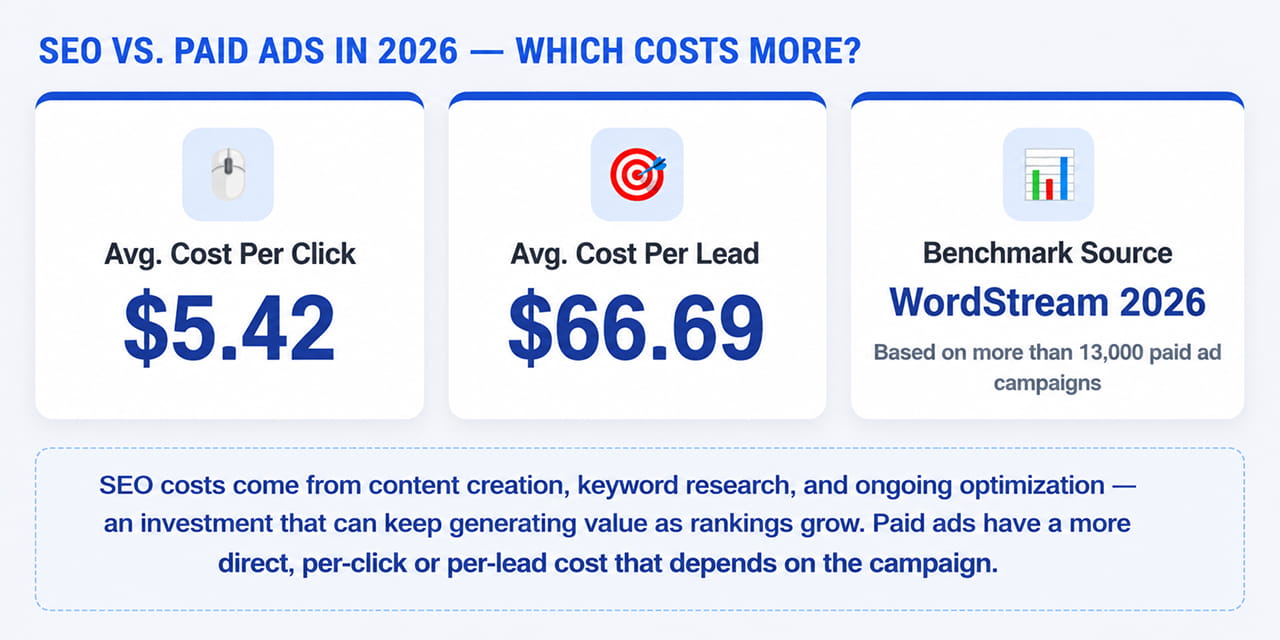
SEO and paid advertising have different cost structures, so comparing them only by the amount spent can be misleading.
SEO spending can include content creation, keyword research, technical SEO, website improvements, and ongoing optimization. The investment may take time to produce a return, but the work can continue generating value as the website gains rankings and builds a larger library of useful content.
Paid advertising has a more direct cost. Depending on the campaign, businesses may pay for clicks, impressions, leads, or another defined campaign goal. The original article cites WordStream’s 2026 benchmark report, based on more than 13,000 campaigns, which puts the average cost per click across industries at $5.42 and the average cost per lead at $66.69. Actual costs can vary considerably by industry and competition.
The important point is that SEO and paid ads should be evaluated based on business results, not simply on the initial cost of each channel.
Which Gives Better ROI?
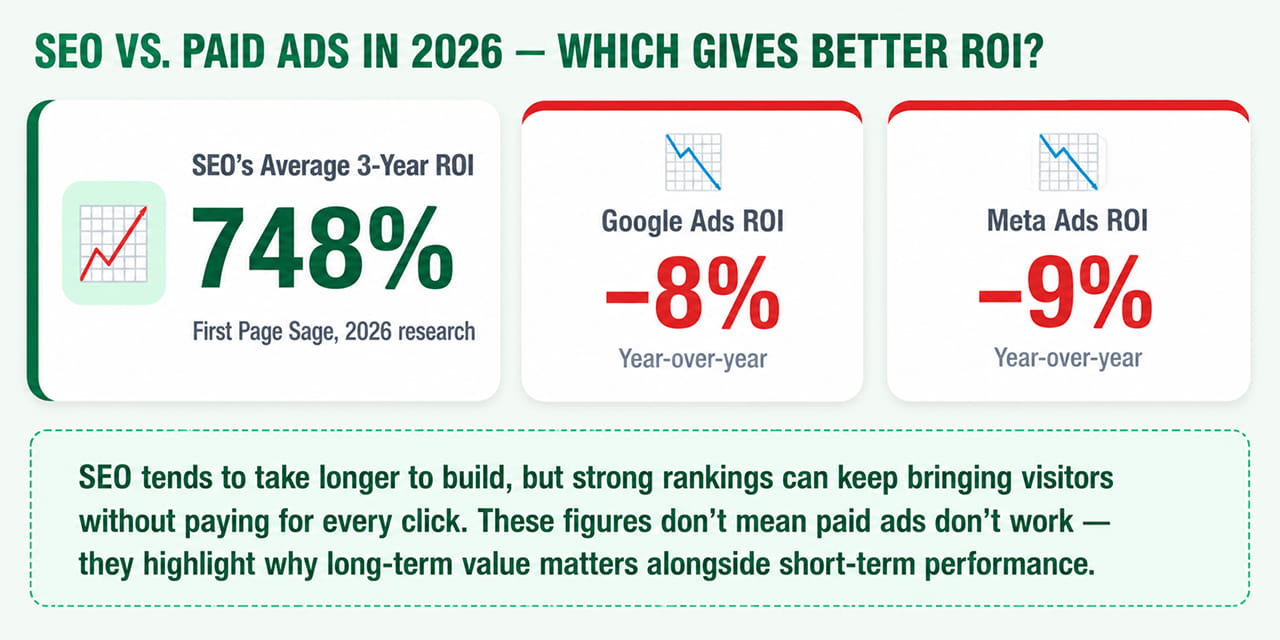
Both SEO and paid ads can produce a return, but the timing of that return is different.
Paid advertising can generate results quickly because a business can start sending visitors to a website as soon as a campaign becomes active. This makes paid ads useful when a company needs leads, sales, or visibility within a short period.
SEO generally takes longer to build. However, once a website earns strong rankings, those rankings can continue bringing visitors without a separate payment for every click.
The original article cites First Page Sage’s 2026 research, which reports an average three-year ROI of 748% for SEO and higher long-term ROI for SEO compared with Google Ads and Meta Ads. It also reports year-over-year declines of 8% for Google Ads ROI and 9% for Meta Ads ROI.
These figures should not be interpreted as proof that paid advertising does not work. Paid ads can be extremely effective when speed, targeting, and control are important. They simply highlight why businesses should consider both short-term performance and long-term value when allocating their marketing budget.
What About Lead Quality?
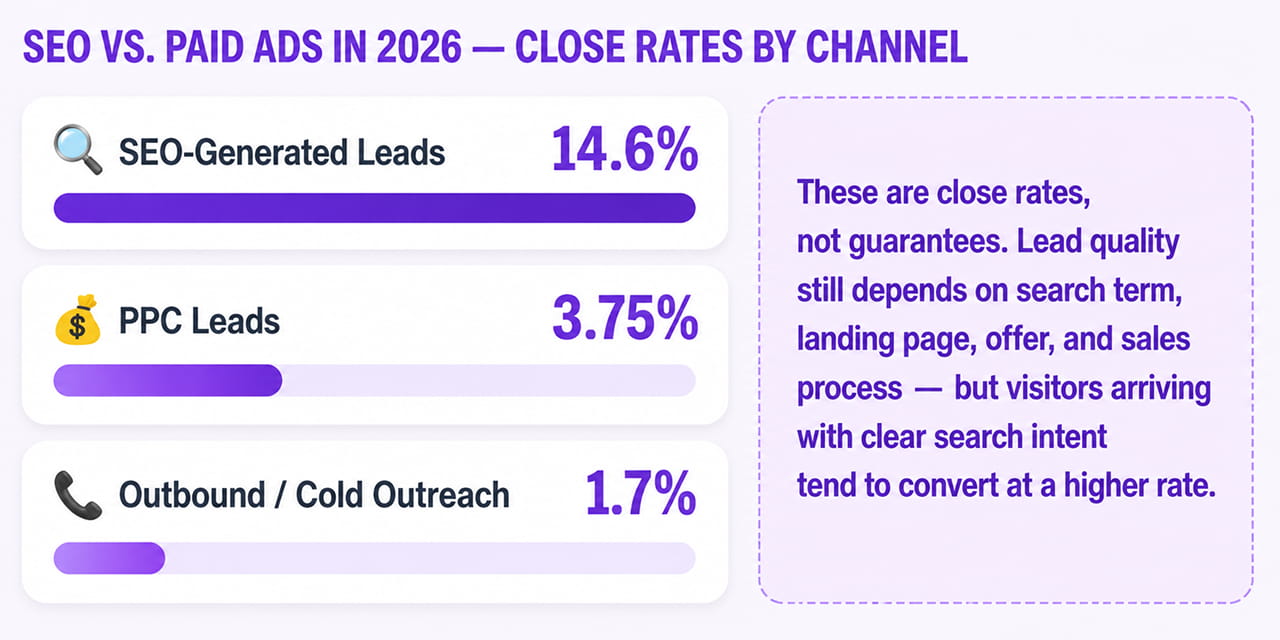
Getting traffic is only part of the goal. The more important question is whether that traffic can eventually become real business.
Someone who reaches a website after searching for a specific product, service, or solution may already have a clear need. That can make search traffic particularly valuable for businesses that target customers with strong buying intent.
The original article cites industry benchmarking that puts the close rate for SEO-generated leads at roughly 14.6%, compared with 3.75% for PPC leads and 1.7% for outbound or cold outreach.
These numbers are not guarantees. Lead quality depends on the search term, landing page, offer, audience, sales process, and overall marketing strategy. A well-targeted paid campaign can produce excellent leads, just as poorly targeted SEO traffic may produce very little business.
When Does SEO Make More Sense?
SEO usually makes more sense when the goal is long-term growth. If a business wants to build search visibility and create a steady source of organic traffic, consistent SEO investment can be valuable.
SEO is particularly useful when a company can give its strategy time to develop. A business can create useful pages around its services, answer common customer questions, improve its website, and gradually build visibility for more relevant searches.
For example, a company offering website services could create helpful content around website development, website performance, and related customer questions. As these pages become more visible in search, they can continue attracting potential customers after publication.
The website experience matters too. SEO traffic needs a useful destination. Professional website design can help make sure visitors can understand the offer, find information easily, and take the next step.
When Do Paid Ads Make More Sense?
Paid advertising is often the better choice when speed matters. Imagine a company is launching a new service next month. Its website may not yet rank for the keywords connected to that service, and waiting for organic rankings could take too long.
Paid ads can put the new service in front of potential customers while the business continues building its organic visibility.
Paid campaigns can also be useful for seasonal promotions, limited-time offers, product launches, and situations where a business needs leads within a specific period. Because the campaign can be adjusted quickly, businesses can test different audiences, offers, and messages and use the results to improve future marketing.
Should a New Business Focus on SEO or Paid Ads?
A new business can benefit from both, but each channel can have a different job.
Paid ads can help generate traffic and leads while the business builds its organic presence. At the same time, SEO can begin creating the foundation for future traffic. This combination can be useful because a new website usually has few established rankings, so relying entirely on SEO may mean waiting longer for meaningful results.
As the website gains organic visibility, the business can review its paid campaigns and determine which areas of the budget are producing the strongest results. Over time, the balance between the two channels can change.
What If Your Business Already Gets Organic Traffic?
A business that already receives consistent organic traffic has a different starting point. Continuing to invest in SEO can help protect existing rankings and expand visibility into additional searches.
Paid advertising can then be used to fill specific gaps. For example, a company may rank well for several important service-related searches but struggle to appear for highly competitive keywords. Paid ads can provide additional visibility while the business works on improving its organic position.
This is where a broader digital marketing strategy becomes useful. SEO, paid advertising, social media, content, and other channels can work together instead of being treated as completely separate activities.
Can SEO and Paid Ads Work Together?
Yes. In many cases, using both can be more practical than relying entirely on one channel.
Paid ads can generate immediate traffic while SEO is being developed. The information collected from paid campaigns can also help improve the organic strategy. If a particular keyword consistently produces quality leads through advertising, for example, that keyword may be worth targeting through SEO as well.
Over time, a business can build a stronger source of organic traffic while continuing to use paid advertising for areas where it provides the most value.
Which Should You Choose in 2026?
There is no single percentage of the marketing budget that every business should put into SEO or paid advertising.
A new business that needs customers quickly may need to place more emphasis on paid ads. An established business with strong organic visibility may have more reason to invest in SEO. Industry competition also matters. Some search terms can be very expensive to advertise for, while highly competitive organic results may take longer to establish.
The best approach is to match the marketing channel to the business goal. If you need traffic quickly, paid advertising can help. If you want to build a long-term source of organic traffic, SEO is important. If you need immediate leads while developing your organic presence, using both may be the strongest approach.
SEO vs. Paid Ads: The Bottom Line
SEO and paid ads are not simply two versions of the same marketing strategy. SEO takes time, but successful organic rankings can continue bringing visitors without a payment for every click. Paid ads can create immediate visibility, but that visibility depends on continued advertising spend.
For many businesses, the most effective strategy is not choosing one and ignoring the other. Paid ads can support short-term goals while SEO builds a longer-term source of organic traffic. The right balance depends on the business’s goals, budget, competition, website strength, and current online visibility.
Not Sure Where Your Marketing Budget Should Go?
SEO and paid advertising serve different purposes, and choosing the right balance can make a meaningful difference to your marketing results. Whether you need immediate visibility, long-term organic growth, or a strategy that combines both, the right approach starts with understanding what your business needs most.
Reach out through our contact form and we’ll get back to you promptly. Let’s build a digital marketing strategy that puts your budget to work across the channels that can deliver the strongest results for your business.


 +91 8277203000
